
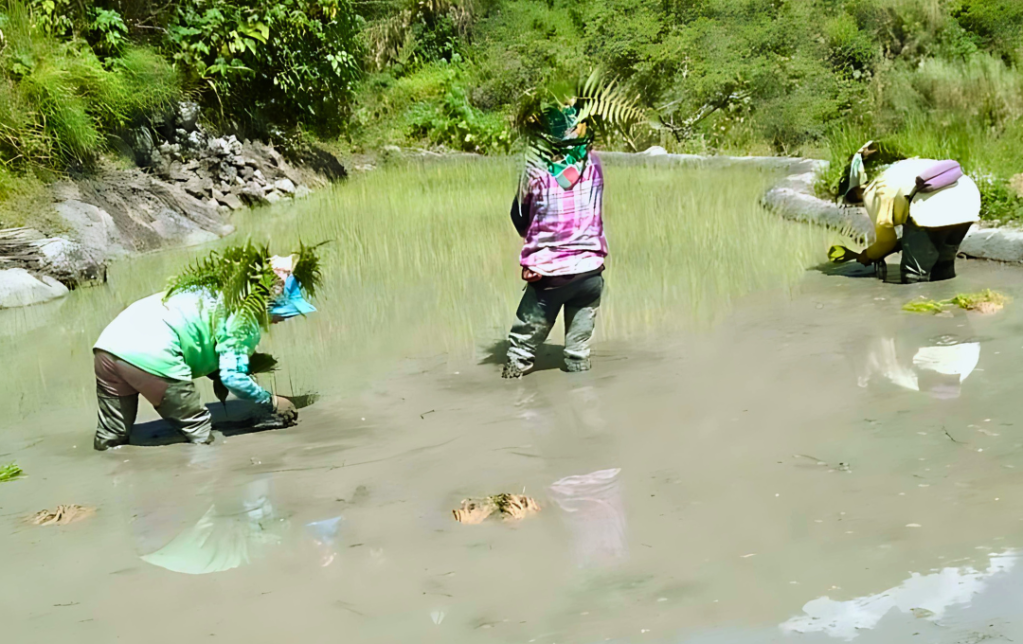
The beginning of the year is the start of planting the leading staple food of the Sadanga folks and the entire Philippines – the majestic rice!
It is said that there is a specific season and timing for every purpose under the heavens. An excellent illustration of this is how the folks of Sadanga synchronized their courses of life with the rhythm of nature and the mood of each season.
- Sadanga, a Distinct World
- Cultural Importance of “Erag” in Sadanga
- Ritual of Rice Planting
- Joy of Night Rice Planting
- Field Adventure during “Ap-apoy”
- Did You Know…
Sadanga, a Distinct World
Sadanga is a remote place between Bontoc, Mountain Province’s capital, and Tinglayan, Kalinga. It exists as a distinct world, detached from the hustle and bustle of city life. In every season, they have activities that make them fully occupied.
Cultural Importance of “Erag” in Sadanga
The planting of rice, known as ‘erag,’ holds a significant place in Sadanga’s culture. It is not just a seasonal activity, but a deeply rooted tradition that symbolizes the community’s unity and resilience, making everyone feel a part of something bigger.
“Erag” is the main activity of rice farmers from January to March, but due to climate change, the planting is now done from February to April. “Erag” is the transfer of rice seedlings they call “panar” from the seedling bed to the already plowed fields. This is done by either carabao, a domesticated water buffalo commonly used in Southeast Asia for plowing fields, or “kuliglig, “a hand tractor used for various farming tasks. These traditional tools are still widely used in Sadanga, reflecting the community’s commitment to preserving their cultural heritage and sustainable farming practices.
Ussually, “sinpangubfo” (bayanihan) mostly do the rice planting. However, it welcomes participants of all ages, including children, teenagers, and elders. Even the youngest ones, still immersed in playful moments with their snotty noses, can be seen joining the older ones.
Ritual of Rice Planting
A. Preparation and Transfer of Rice Seedlings
Rice planting starts with uprooting rice seedlings from the seedling bed—primarily a portion of the rice field. Women usually do this since they are more careful ing handling and maneuvering the fragile “panar.”
Sometimes, when the field is small, the owner grows the seedling in a different plot of ricefield nearer to the area for convenience. At least two women in the group are assigned to gather the “panar” (rice seedlings) from another seed bed and bring them to the readily plowed fields for planting.
B. Elders Role During Rice Planting
When planting the rice seedlings, elders supervise the young ones. They teach them the correct distance from one seedling to the other, the depth of the planting, and the number of seedlings you stick on the rice bed. All of these aspects differ in the type of rice they are planting.
On the other hand, beginners should keep up with the group’s speed when planting. Starters plant side by side with the fast planters so the faster ones can help them cover their portion. But if an individual is too slow, others may enclose them with the rice seedling, and it’s up to the slow pacer to find their way out.
Sometimes, gentlemen tease ladies in the group by planting rice seedlings around them. It is also one legal technique, a gentleman uses to hold a lady’s hand to help her exit the enclosure.
C. Humor and Songs to Enliven the Planting Process
When boredom strikes because of the repetitive activity, the group sparks humor to liven the atmosphere. Others, especially the elders, sing songs like “Salidummay,” and everyone joins the chorus.
This integration into the “erag” teaches the kids and beginners to be socially ready when others throw jokes at them. It also helps to relieve fatigue since the mind is busy with happy hormones produced by the jokes and relaxing songs they sing.
Joy of Night Rice Planting
At times, rice planting extends into the night. The scattered faint lights dotting the roundabout of the rice paddies indicate that farmers are still actively planting. In this instance, their children usually help them after school hours to complete the planting of rice seedlings, persisting even in the darkness of night.
Surprisingly, teenagers do love doing the “erag” in the faint light from artificial lights, especially when their friends help them. You can sense this at Maatong hot spring when you happen to bathe with them.
Field Adventure during “Ap-apoy”
Once the majority of fields were planted, the “ap-apoy” tradition followed. During this event, families collectively visited their rice fields and cooked native chicken (commercially raised chickens are never used).
They also bring “fvayash” (sugarcane wine) to pair with the chicken and a stalk of a certain hoya plant that serves as their “pudong“(a symbol that means sealed against any bad omen).
On this occasion, they pray to “Kabunian,” their god, for crop protection against calamities and pests.
“Ap-apoy” offers an open invitation for visitors to join the thanksgiving celebration. However, they are advised to enjoy the occasion without indulging too much with wine and alcohol. This tradition reflects the community’s emphasis on collective participation and mutual respect, as well as their openness to sharing their cultural practices with outsiders.
Did You Know…
Sadanga folks have a unique “erag” tradition that exists and is vibrantly practiced to this day. One of which is that before the “erag” (planting rice) starts, the Isadanga exercises 1 – 3 days of rest, known as “te-er na rapo.” They believe that the goddess of their fields should not be disturbed for this three-day rest.
Also, visitors are not allowed to enter the place (not even the highest position on the land). Anyone violating this specific “te-er” is penalized with a pig! Let that sink! They are extremely strict about this.
After the rest days, the family that owns a specific rice field with a stone at the center in the Fokong, Sacasacan area must initiate the rice planting, and the others follow. So, no matter what your status in the community is, you are powerless in this situation. The Isadanga folks do not acknowledge your authority.
As awkward as it sounds, they still practice this to this day. It’s puzzling, and I’ll try to find out as my research continues. But if you have any ideas, you may write them in the comment section.

Try Our Premium Blog Writing and Content Article Editing Services!
 NorthlandFolks
Leave a comment